Guide · Updated 23 October 2026
Lead distribution API: sending, posting and receiving leads
Short answer
A lead distribution API lets other systems send leads into the platform, and lets the platform deliver them to buyers and report results. Publishers post or ping leads in with a key. The platform filters and routes each lead and delivers it to the winning buyer's endpoint. Your own systems can read leads and reports through API tokens.
Three directions of traffic
| Direction | What happens |
|---|---|
| In | A publisher or form posts or pings a lead to the platform with an API key |
| Out | The platform delivers the lead to each buyer's endpoint, mapped to their fields |
| Back | Your own systems read leads, sales and reports using API tokens |
What to look for
- Clear documentation, ideally an OpenAPI description.
- Separate keys for publishers posting leads and for your own tooling.
- Per-buyer delivery: field mapping, headers, timeouts and reading the buyer's reply.
- Test leads so you can check an integration before it earns money.
- A way for AI assistants to work inside your account safely.
The pingtype API
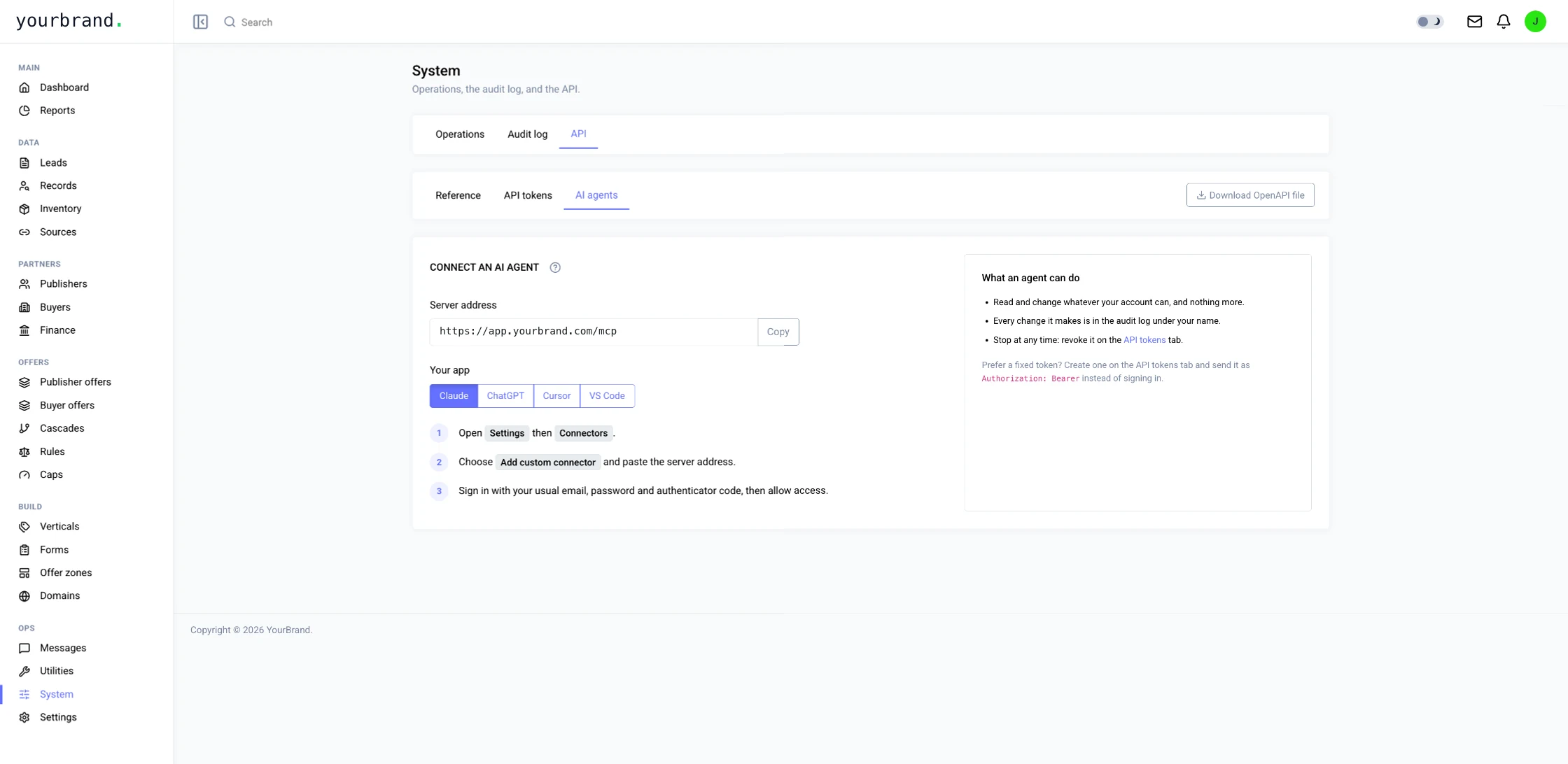
pingtype has a REST API with API tokens and an OpenAPI description. Buyers receive leads with field mapping, JSON and a key header, and replies are parsed so acceptance is recorded. A connector lets Claude, ChatGPT, Cursor and VS Code work under your own login, with each change recorded in the audit log.
Questions
What is a lead distribution API?
An interface that lets systems send leads into a platform and receive them out to buyers, with results readable by your own tools.
Does pingtype have an API?
Yes. It has a REST API with tokens and an OpenAPI description, plus an AI-assistant connector.